- EVENT
- TOPICS
Nepal Exchange Training Program Student Reports
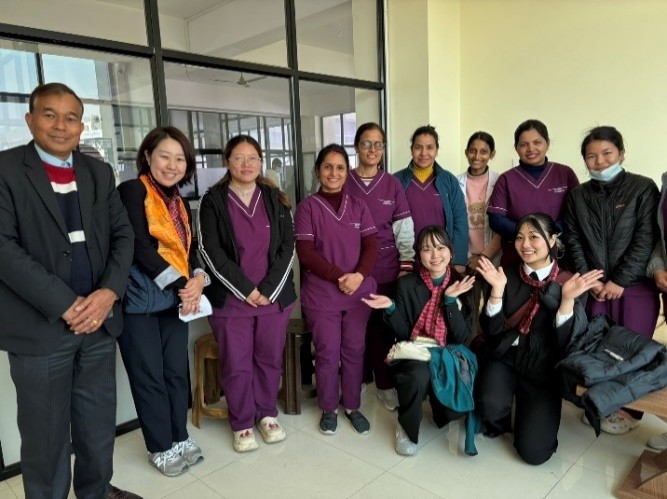
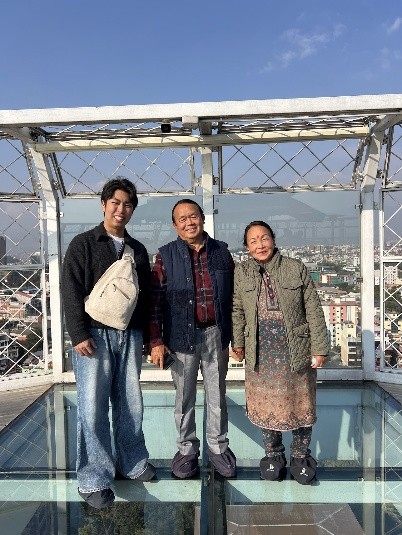
Our university sends and receives trainees every other year in partnership with the Hachigauda Welfare Association—an NPO based in Kathmandu, Nepal, that conducts volunteer activities aimed at improving residents’ healthcare and living conditions. The 2025 delegation consisted of 6 university students, 4 students from Kobe Tokiwa Girls’ High School, 2 alumni, and 5 faculty and staff members, for a total of 17 participants. They conducted training in Kathmandu from December 21 to 28, 2025. Below are reports from the participating students.
Faculty of Health Sciences, Department of Oral Health, Second-Year Student (at the time of participation): Y.K
My one-week training program in Nepal was a deeply memorable experience that began with anxiety and tension but, before I knew it, I felt warmth and comfortable. Before departure, I was honestly more afraid than excited—worried about differences in culture and living conditions, and whether I would be able to communicate in a foreign language. However, once I settled in there, I realized that Nepal was not a frightening place at all; rather, it was a country where I could strongly feel the kindness and warmth of its people.
What left the deepest impression on me was my homestay experience. Even though we could not communicate perfectly through language, my host family welcomed me with smiles and made great efforts to communicate using gestures and facial expressions. We shared meals together, and they repeatedly asked, “Is it good?” while also showing concern for my health. I truly felt that they cared for me as a member of their family. This experience taught me that even without perfect English, a smile and a genuine desire to communicate can bridge any gap. Despite being in a foreign country, I felt very comfortable and at home, as if I could say, “This is my home.” These memories will always be special.
Walking around the city also left a strong impression. At first, I was confused by the differences from Japan, but gradually, as I encountered people’s calm expressions and natural smiles when passing by, my tension began to ease. Although the city was lively and full of energy, there was also a sense of warmth in the atmosphere that made me want to learn more about the country and immerse myself in it.
During visits to educational institutions, the children made a particularly strong impression on me. More than just their motivation to learn, what stayed with me was the sparkle in their eyes. It was clear that they truly valued the act of learning itself. Seeing them made me realize that the desire to learn is not determined solely by the richness of one’s environment, but is supported by one’s attitude and mindset.
At medical facilities, I was often surprised by the differences compared to Japan. Even though equipment and resources were limited, I saw healthcare professionals treating each patient with great care and attention. This made me reflect on what is truly important in healthcare. While having well-developed facilities is certainly important, I felt that compassion and the willingness to stand by patients are at the very core of medical care.
Through this training, I learned that understanding different cultures is not just about recognizing differences, but also about putting yourself in others’ positions and accepting them with empathy. The kindness and warmth of the people I met in Nepal transformed my anxiety into a sense of comfort and inspired me to learn more about the world. As I work toward becoming a dental hygienist and interacting with many people in the future, I hope to never forget this experience and to be someone who can truly understand and support everyone. The lessons I gained in Nepal will continue to be something I cherish and nurture throughout my life.
Faculty of Health Sciences, Department of Radiological Technology, Third-Year Student (at the time of participation): A.I
This program was filled with “firsts” for me—my first time traveling abroad, my first time on an international flight, and my first homestay. Everything about the experience was new and stimulating. When I first met the other participants, I felt anxious because there were no male students and I was the oldest member. However, by the end of the program, I felt truly grateful for this group, as they became irreplaceable companions.
The moment I arrived at Kathmandu Airport and stepped outside, I was struck by the loud honking of horns, the heavy traffic, and the clouds of dust. It made me realize, with a sense of tension, that I was really in Nepal.
The following day, I met my host family. Upon arriving at their home, I was surprised to find that it was very different from what I had imagined Nepal to be like. It was surrounded by nature, with clean air and a panoramic view of Kathmandu, leaving me with an unexpected impression. As we continued to converse, I became painfully aware of my limited vocabulary. I had things I wanted to express, yet I could not put them into words. Carrying this frustration, I spent my days with my host family.
What left the strongest impression on me was the visit to Nepal Medical College and its affiliated hospital. At the medical college, I saw real human specimens on display, and I was even told that taking photographs was allowed. In Japan, due to respect for individual dignity, opportunities to see real specimens are extremely rare. While I was deeply shocked, I was also left questioning the differences in how personal dignity is perceived. At the affiliated hospital, I experienced a similar sense of difference. For example, there were hospital wards without partitions, and personal information was openly written in the hallways. It felt as though the concepts of privacy and information protection—strictly upheld in Japan—were not present. Although this may reflect the characteristics of the country, it was a striking experience.
Another aspect that left a strong impression was the presence of CT and MRI equipment. Before this trip, a friend who had participated in a previous Nepal training program showed me photos of outdated general imaging equipment that is no longer used in Japan. Expecting to see similar devices, I visited the hospital, only to be met with these state-of-the-art machines. There was only one such unit in the entire country, yet it was comparable to the equipment I had seen during my clinical training. This made me feel as though I was witnessing a turning point in the country’s medical development. In just two years, such remarkable progress had been made. This is what it means to be a developing country, I thought, and I was very aware of the rapid advancement of medical technology.
On a different day, we visited Ujjwal Tara School. We were welcomed by adorable children who greeted us in Japanese. In the auditorium, as we watched performances and spoke with the students, they communicated naturally in Nepali, English, and even Japanese. Seeing young students effortlessly use three languages made me reflect on the difference in attitudes toward language between Nepal and Japan. In Japan, it is possible to live without knowing English. However, in Nepal, English and Japanese are essential for living and earning a livelihood. To earn more, many people must go abroad to work, and for that purpose, language acquisition becomes necessary. I felt that their learning is driven by the need to live and to support their families. Their attitude toward learning is something we should learn from.
Finally, I would like to reflect on my personal goal for this program: to eliminate my bias toward foreigners. Because of this experience, I feel that I have developed a more neutral and open perspective. I realized that there are things you cannot truly understand unless you see and experience them firsthand. Trying to understand others is the first step in overcoming prejudice. I am glad that I was able to take that step through this program. In the medical field, care is provided equally to all patients, regardless of nationality. I hope to make use of this experience as I strive to become a healthcare professional who can treat everyone equally and save lives without discrimination.